Male Cat Straining to Urinate: Signs, Causes & What to Do Right Now
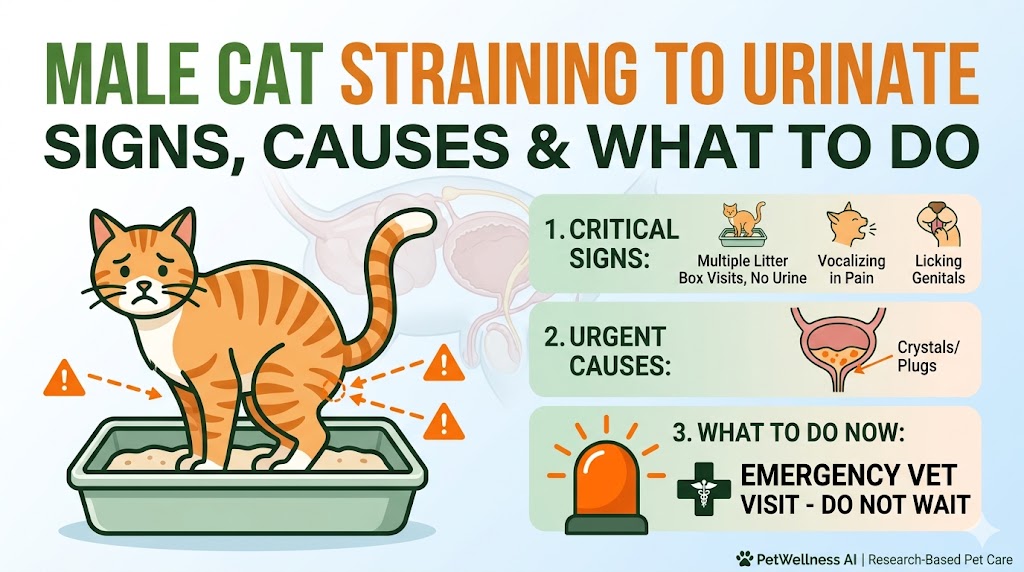
A male cat straining to urinate with little or no urine is an emergency. He may have a urinary blockage, which can become life-threatening within a day or two. Take him to a vet or emergency clinic now. Don't wait to see if it passes, and don't try home remedies first.
You notice your cat crouched in the litter box, pushing hard and producing nothing, or just a few painful drops. This is one of the most serious situations a cat owner can face, because a complete blockage can become fatal within a day or two if it isn't treated.
This guide explains why it happens, what to do in the emergency, what your vet will do, and how to lower the chance of it happening again.
Why Male Cats Are Uniquely Vulnerable
Anatomy is the key. Male cats have a longer, narrower urethra than females, and it narrows further toward the tip of the penis, to roughly a millimeter wide.
Female cats have shorter, wider urethras. When crystals, mucus or inflammatory material build up in the bladder, females can usually pass them. Male cats often can't. The material lodges in the narrow section, urine backs up, the bladder stretches, and waste products that should leave the body build up in the blood.
That narrow tip is why even small urethral plugs can cause a complete blockage, and why urinary obstruction is overwhelmingly a problem of male cats.
Key Takeaway
Male cats are at high risk of urinary blockage because their long, narrow urethra traps crystals, mucus plugs and inflammatory debris that a female cat would usually pass.
Emergency Signs You Cannot Ignore
Early straining can look like constipation, and many owners lose valuable time thinking their cat is struggling to pass stool. If your male cat is straining in the litter box, assume it's urinary until a vet says otherwise.
Watch for these signs:
Repeated trips to the litter box with little or no urine: the defining sign of obstruction
Crying or vocalizing in the litter box: a sign of pain
Frequent licking of the genital area
Straining with no result: hunched over, pushing hard
Restlessness and inability to settle
A painful or tense belly
Lethargy and hiding, as waste products build up
Vomiting, common as a blockage progresses
If your male cat is straining and producing little or no urine, this is a veterinary emergency now. Don't wait a few hours, don't wait overnight, and don't try home remedies first. Go to your vet or the nearest emergency clinic.
Time matters. In a blocked cat, potassium builds up in the blood and can cause dangerous heart rhythm problems. In rare cases the bladder can rupture. Both are why blockages are treated as emergencies.
Key Takeaway
A male cat straining with little or no urine, especially if he's crying out or has a tense belly, needs an emergency vet right now. Don't wait for a morning appointment.
What Causes a Urinary Blockage in Cats
There's often more than one factor involved. Understanding each one helps with prevention once the emergency is over.
Cause
What it is
Risk factors
Urethral plugs
A mix of mucus, inflammatory cells and often crystals that forms a soft plug
Dry food diet, low water intake, stress
Struvite crystals
Magnesium ammonium phosphate crystals that form more easily in less acidic urine
Concentrated urine, diet
Calcium oxalate crystals
Dense crystals that form in more acidic urine and can't be dissolved with diet
Age, breed, concentrated urine
Bladder stones (uroliths)
Hardened mineral stones that can move into and block the urethra
Ongoing crystal formation, concentrated urine
Feline idiopathic cystitis (FIC)
Bladder inflammation with no infection or stone, closely linked to stress
Indoor living, multi-cat homes, changes in routine
Urethral spasm
Painful tightening of the muscles around the urethra
Inflammation, pain, after catheterization
Tumors (rare)
Bladder cancer obstructing urine flow
Older cats
Urethral plugs and FIC are the most common causes in younger male cats. Across studies of cats with lower urinary tract signs, FIC is the most frequent diagnosis. A German study found it in 55% of cases, far ahead of bacterial infection or stones.[4]
If your cat has other urinary changes, such as going more often or urinating outside the litter box, but isn't straining, you can run their symptoms through our free cat symptom checker, which flags warning signs that need a vet first. If he's straining with little or no urine, skip the checker and go to a vet now.
The Biology Behind the Blockage
How crystals form
Crystals form when minerals become too concentrated in the urine. Struvite crystals form more easily when urine is less acidic, and calcium oxalate crystals when it's more acidic. Concentrated urine from low water intake raises the risk of both. Crystals can then bind with mucus and inflammatory material to form a plug.
The stress connection
Feline idiopathic cystitis isn't caused by infection. Research suggests it results from interactions between the bladder, the nervous system and the body's stress-response system.[2] Cats with FIC tend to show heightened "fight or flight" nervous system activity combined with a blunted cortisol response to stress. Their bladder lining, including the protective layer that normally shields the bladder wall from urine, is often less effective. The result is inflammation that produces the debris and mucus that can form plugs, even without crystals.
Why potassium makes this an emergency
When urine can't leave the body, potassium builds up in the bloodstream. High potassium (hyperkalemia) interferes with the heart's electrical activity, slowing the heart rate and potentially causing fatal heart rhythm problems. This is why vets stabilize the heart and fluids of a blocked cat as a first priority.
Key Takeaway
Blockages can involve crystals, inflammation or both. Stress plays a real role in feline idiopathic cystitis, so stress management is part of long-term prevention, alongside diet and water.
Is Your Cat Showing Urinary Symptoms?
If your male cat is straining with little or no urine, go to a vet now. For other urinary changes, our free AI symptom checker flags warning signs first, then explains possible causes to discuss with your vet.
If you suspect a blockage (little or no urine, crying, a tense belly), the only correct response is an emergency vet visit. There is no home remedy that safely clears a urethral obstruction.
While you get there:
Don't press on the belly. An overfull bladder can rupture. Don't squeeze, poke or massage the abdomen.
Keep your cat calm and contained. Use a carrier lined with a soft towel.
Call the clinic on the way so they can prepare for a possible blocked cat.
Note the timeline. Tell the vet when you last saw your cat pass a normal amount of urine.
If he's passing small drops, it may be a partial blockage or cystitis. That is still urgent: a partial blockage can become complete at any time, so see a vet as soon as possible today.
Never give your cat human pain medication. Ibuprofen, acetaminophen (Tylenol/paracetamol) and aspirin are dangerous to cats, even in small doses.
What Veterinary Treatment Looks Like
Knowing what to expect can make a stressful visit easier. A typical treatment pathway:
Stabilization: IV fluids and, if potassium is dangerously high, medications to protect the heart.
Sedation or anesthesia: so the vet can relieve the blockage without causing more damage to the inflamed urethra.
Catheterization: a urinary catheter is passed to clear the obstruction and flush the bladder, and is usually left in place.
Hospitalization: often a few days, so the bladder can recover while fluids flush the urinary tract and kidney values return toward normal.
Monitoring: bloodwork for kidney values and electrolytes, and urine output checks.
Going home: usually with pain relief and medication to relax the urethra, plus antibiotics only if an infection is confirmed.
Treatment can be expensive, often running into thousands of dollars depending on severity and how long your cat stays in the hospital. If you have a male cat, it's worth considering pet insurance before a problem arises. If cost is a worry, tell your vet upfront and ask about payment plans or options.
For cats that block repeatedly despite treatment and prevention, a surgery called a perineal urethrostomy (PU) may be recommended. It creates a wider urinary opening and is usually reserved for recurrent cases.
After a first blockage, re-blockage is common, especially in the following weeks and months. That's why prevention matters, and why it needs to cover water, diet and stress together.
Hydration as medicine: Increasing your cat's water intake is one of the most important prevention steps. More dilute urine helps flush the urinary tract and lowers the concentration of the minerals that form crystals.
Wet food as the main diet. Canned food is 70–80% moisture, compared with 8–10% in dry kibble, so it substantially raises total water intake.
Try a water fountain. Some cats drink more from moving water, though studies show the average increase is modest. It's worth trying alongside wet food.
Multiple water stations. Place bowls or fountains in different rooms.
Add water or broth to food. A little warm water, or low-sodium broth with no onion or garlic, adds moisture. Check with your vet first if your cat has kidney or heart disease.
Omega-3 fatty acids (EPA/DHA). These have anti-inflammatory effects, and some vets include them in cystitis management, although evidence specific to FIC is limited. Ask your vet about a pet-specific product and dose.
Key Takeaway
Prevention works best when you combine more water (especially wet food), reduced stress and your vet's diet plan, rather than relying on any one change.
Diet, Water Intake and FLUTD Prevention
Feline lower urinary tract disease (FLUTD) is an umbrella term for conditions affecting the bladder and urethra: cystitis, crystals, stones, infections and blockages. Diet is one of the most changeable risk factors.
Wet versus dry food: In one study of cats with idiopathic cystitis, signs returned in about 11% of cats fed the canned version of a diet, compared with 39% of cats fed the dry version.[5]
Therapeutic urinary diets (such as Hill's c/d or Royal Canin Urinary S/O) are formulated to control urine minerals and pH, and some can dissolve struvite stones. Your vet will advise whether your cat needs one and for how long, especially after a blockage.
Fresh and raw diets are favored by some holistic vets for their high moisture and protein. Controlled evidence for urinary prevention is limited, and raw food carries a risk of bacterial contamination, so any home-prepared diet should follow a recipe balanced by a veterinary nutritionist.
Cranberry and D-mannose are popular for urinary tract infections in people. Bacterial infections are an uncommon cause of urinary signs in young cats, and evidence for these products in cats is limited. They should never be used to treat a blockage.
Stir a tablespoon of warm water, or warm low-sodium chicken broth with no onion or garlic, into wet food. Many cats eat warmed, moistened food readily, which is an easy way to add extra water to every meal.
Stress and Feline Idiopathic Cystitis
Stress is a recognized trigger for feline idiopathic cystitis, and it's often overlooked. Changing the food helps, but if a cat is chronically stressed, episodes can keep coming back.
Common stress triggers in indoor cats:
New pets in the household, especially other cats
Construction noise, moving furniture or renovations
Changes in the owner's schedule, such as a new job, travel or shift work
Competition over food bowls, litter boxes and resting spots
Seeing or smelling outdoor cats through windows
Tension between cats, even in homes where they seem to "get along"
The standard guidance is one litter box per cat plus one extra, in different quiet locations, scooped at least daily. For a cat recovering from a blockage, it's worth offering more than one box even in a single-cat home, so he never has to hold urine because a box is dirty or hard to reach.
Environmental enrichment makes a measurable difference. In a study of 46 indoor cats with idiopathic cystitis, owners reported significant reductions in urinary signs after their homes were changed to reduce stress, using a program called multimodal environmental modification (MEMO).[6] Ideas include puzzle feeders, cat trees and shelves, window perches, hiding spots and daily interactive play.
Pheromone diffusers, such as Feliway Classic, release a synthetic version of the "comfort" scent cats leave when they rub their faces on things. A small pilot study in cats with idiopathic cystitis found a trend toward fewer episodes, but it wasn't statistically significant, and a later review judged the evidence insufficient.[7][8] They're low-risk, and some owners find them helpful as one part of a wider stress-reduction plan.
Key Takeaway
For cats with idiopathic cystitis, reducing stress matters as much as diet. Environmental enrichment has the strongest evidence, along with enough clean litter boxes and less competition between cats.
Life After a Blockage
Getting through the emergency is step one. Lowering the chance of it happening again is the longer job. A practical first month at home:
Weeks 1–2: Follow your vet's discharge instructions exactly and finish all medications. Check the litter box several times a day for normal amounts of urine. If straining returns, go back to the vet immediately.
Weeks 2–3: Move toward a high-moisture diet, following your vet's diet advice. Add water stations in several rooms.
Weeks 3–4: Add environmental enrichment, such as vertical space, puzzle feeders and at least 15 minutes of interactive play a day. Ask your vet whether omega-3 supplementation suits your cat.
Ongoing: Keep follow-up appointments for urine testing, so your vet can check concentration, pH and crystals and adjust the plan.
If your vet wants a urine sample from home, ask about non-absorbent litter kits, which make it easier to collect one. Home dipstick readings from used litter aren't reliable enough to guide diet changes on their own, so leave urine testing and interpretation to your vet.
Key Takeaway
After a blockage, prevention means more water, your vet's diet plan, less stress and regular urine checks. Watch the litter box closely, and treat any return of straining as an emergency.
Frequently Asked Questions
Is a male cat straining to urinate an emergency?
Yes. A male cat straining with little or no urine may have a urinary blockage, which can become life-threatening within a day or two as toxins and potassium build up in the blood. Take him to a vet or emergency clinic straight away. Don't wait to see if it passes.
Can a cat's urinary blockage clear on its own?
You should never wait to find out. Some partial blockages may briefly ease, but a blockage can become complete at any time, and there is no home remedy that safely clears one. A blocked cat needs a vet to relieve the obstruction and stabilize him.
Why do male cats get urinary blockages?
Male cats have a long, narrow urethra that becomes especially narrow near the tip. Urethral plugs made of mucus, inflammatory material and crystals, or small stones, can lodge there. Females have a shorter, wider urethra and rarely become blocked.
How can I stop my cat getting blocked again?
Follow your vet's discharge plan and diet advice, increase water intake (wet food is the most reliable way), reduce stress at home with environmental enrichment and enough litter boxes, and keep follow-up urine checks. Re-blockage is common, so watch the litter box closely and act fast if straining returns.
Want more help? Our free AI symptom checker gives you emergency warning signs first, then possible causes and natural support ideas for your cat's specific situation.
PetWellness AI is run by a lifelong animal lover and dog owner who has spent years researching natural, evidence-informed care for real pet health problems. Every article is checked against published veterinary research, drafted with the help of AI tools, and reviewed before publishing. We're not veterinarians, so we always point you to your vet for diagnosis and treatment. Our story →
Citations & Sources
"2025 iCatCare consensus guidelines on the diagnosis and management of lower urinary tract diseases in cats." J Feline Med Surg. 2025. PubMed Central
Buffington CAT. "Idiopathic cystitis in domestic cats — beyond the lower urinary tract." J Vet Intern Med. 2011. PubMed Central
Gerber B, et al. "Evaluation of clinical signs and causes of lower urinary tract disease in European cats." J Small Anim Pract. 2005. PubMed
Dorsch R, et al. "Feline lower urinary tract disease in a German cat population: a retrospective analysis of demographic data, causes and clinical signs." Tierärztliche Praxis. 2014. PubMed
Markwell PJ, et al. "Clinical evaluation of commercially available urinary acidification diets in the management of idiopathic cystitis in cats." JAVMA. 1999. PubMed
Buffington CAT, Westropp JL, Chew DJ, Bolus RR. "Clinical evaluation of multimodal environmental modification (MEMO) in the management of cats with idiopathic cystitis." J Feline Med Surg. 2006. PubMed Central
Gunn-Moore DA, Cameron ME. "A pilot study using synthetic feline facial pheromone for the management of feline idiopathic cystitis." J Feline Med Surg. 2004. PubMed Central
Frank D, Beauchamp G, Palestrini C. "Systematic review of the use of pheromones for treatment of undesirable behavior in cats and dogs." JAVMA. 2010. PubMed
Merck Veterinary Manual. "Urolithiasis in Small Animals." MerckVetManual.com
Disclaimer: This article is for informational purposes only and does not constitute veterinary advice. If your cat is showing signs of a urinary obstruction, seek emergency veterinary care immediately. Read our full disclaimer.